The Philosophy and Heart Work of Co-Dreaming
A liberation-centered framework for reimagining volunteer engagement, centering community ownership, and creating service spaces built on shared care.
You showed up here becauseYou lead volunteers — in a nonprofit, a corporation, a university, a service-learning program, or anywhere people show up to serve. You have the authority to change how that service is designed, resourced, and measured. And somewhere in you, you already know that what you're doing is not working the way you hoped it would.
Where it beginsVolunteerism,
we need to talk.
Growing up, my father built a tapestry of care around our family. When we'd go into town, he'd introduce me to a cousin. Nine times out of ten, there was no blood relation — but the moment he made that introduction, that person became part of my community. His stamp of approval meant something. It meant: if you are ever in a bind, look for a cousin. You will get what you need.
That was an ecosystem of care. Informal, relational, community-sovereign. When I entered the nonprofit sector, I went looking for that same thing.
What I found instead was KPIs. Volunteer hours. Governance structures. Boards. Strategic plans. And I kept asking myself: but where are the people? In my experience — and in the experience of many others — formal volunteerism had lost its way. Extraction, transaction, and power-hoarding had become best practices. Saviorism and paternalism were dressed up as expertise and empathy. I felt it every day in my gut.
“Co-Dreaming demands that we keep community at the center of volunteerism, and along the journey, real repair, rebuilding, and reimagining can take place.”
We stop at need. We recruit and place and measure hours — and we forget about right relationship. We design programs around deficits without ever asking communities what success and flourishing actually means to them. And when they are left out of that question, our mission fails.
That gap — between the ecosystem of care my father built and the extractive systems I kept encountering — is the origin of Connecting the Cause and the Co-Dreaming Framework.

a definitionCo-Dreaming in Volunteer and Community Engagement recenter communities - not volunteers - as the primary reference point for defining purpose, participation, success, care, and impact.
It calls us to identify the ways we center volunteer preferences, organizational systems and management over communing with community in deep relationship and honorable stewardship in order to dismantle the before and create a repaired present and the forward path.
Co-Dreaming reframes volunteers and communities as co-creators of mission and social change rather than positioning communities as passive recipients of service.
In other words:
The question is not "How do we create a better volunteer experience?"
It is "How do volunteer engagement structures align with community-defined thriving, dignity, autonomy, and collective wellbeing?”
Communities are the holders of wisdom, power, and agency so that organizations can walk alongside in partnership, accountability, and solidarity towards current and future collective liberation for all.
What this requires of youIntentional solidarity. Partnership. Courage. Communing.
Co-Dreaming asks you to feel differently about communities and it asks you to build differently as well. We must examine who holds decision-making power in your volunteer engagement strategy. We must ask whose definition of success is being used. We must look honestly at whether your intake processes, your communications, your volunteer orientations, and your culture are centered on the comfort and timelines of the server — or on the wisdom and agency of the community members you are walking alongside.
We also must know that this is not fluffy or good to haves. These questions point to infrastructure and operations. Shared care and community-centric(ness) can be designed, and require accountability structures, relationships, and humility.
If you lead volunteers and you are willing to ask those questions out loud, Co-Dreaming gives you the framework to act on what you find.

“
The framework — visualized
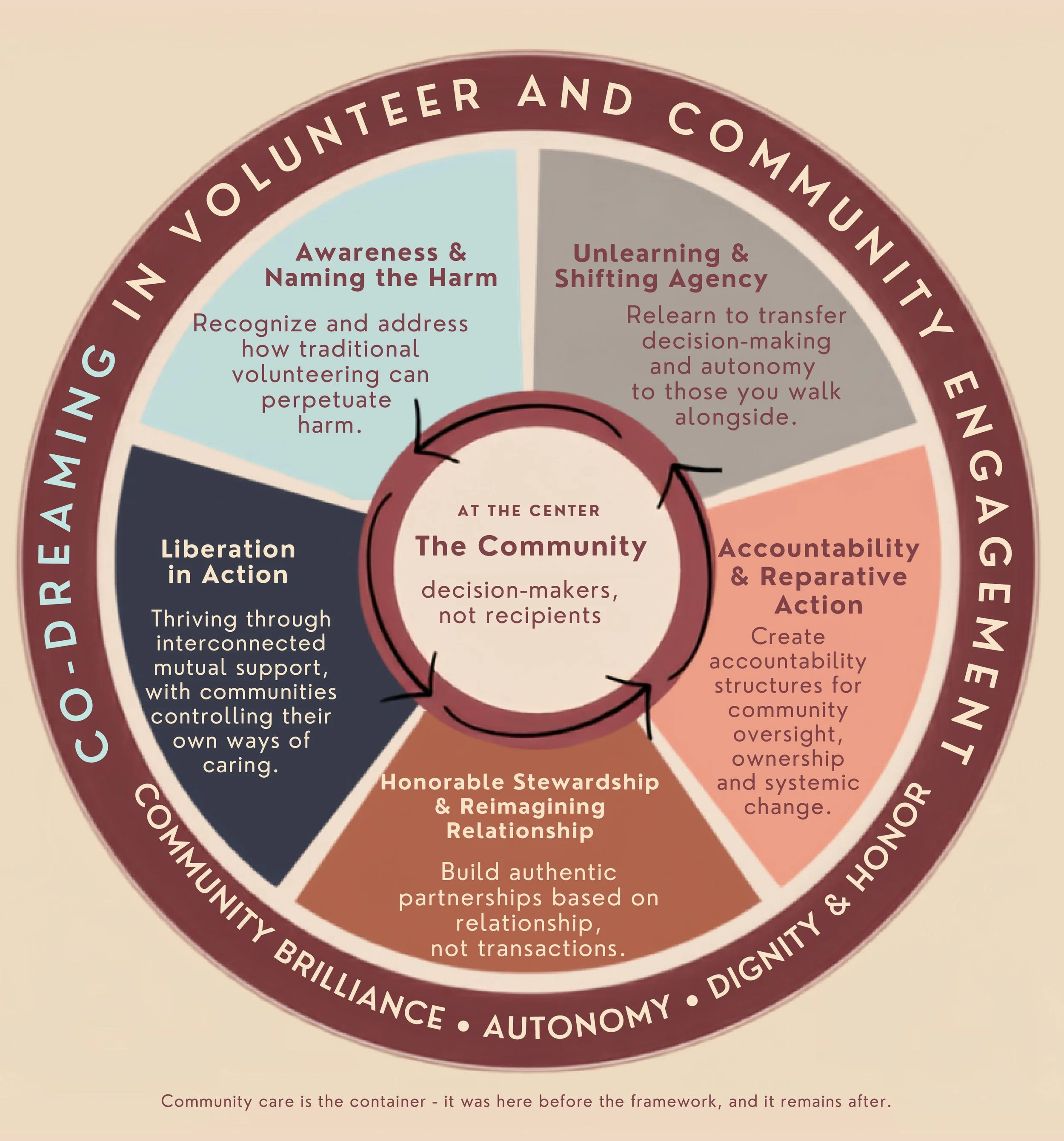
The Co-Dreaming Framework circular because liberation is not a destination you reach and check off. The five phases move in a cycle, each one feeding the next. At the center is the Ecosystem of Community Care. It's the thing every phase exists to protect and grow. Surrounding the entire structure is the outer ring: Community Brilliance, Autonomy, Dignity, and Honor.
Before any phase begins, these four must already be true.
Four foundational values surround the entire Co-Dreaming structure as non-negotiable conditions to begin from. They are the outer ring of the framework because they are not a phase but is constructed as the atmosphere the entire framework breathes within.
Why the outer ring
Please note, you do not arrive at Community Brilliance or Dignity after completing phase one. You bring it in on day one as a truth to hold on through throughout the framework. The outer ring is a reminder that this work begins with who you decide the community already is.
-
Start here. Always.
You are bringing good into an already good community. Communities are not broken and are not waiting to be rescued. They are brilliant, understand how to mold and shape things for their flourishing, and are resourced at every angle — with wisdom, and solutions that exist independent of any organization's intervention. We begin by honoring that truth.
-
Their freedom is not under your surveillance or control
Decision-making power belongs to the community in every step of the way and "giving them power" not should not be seen as an award for them participating well or for agreeing with everything you've already made a decision on.
-
It's innate.
Every community member is a full human being and should never be reduced to a case number, photo op or "learning opportunity." Dignity is the minimum standard before any engagement begins.
-
Relationship over transaction.
Showing up in someone's community is a sacred act. Honor means treating community knowledge as a gift, community time as precious, and community feedback as an open opportunity for challenge, exploration, and good trouble!
The five phasesHow Co-Dreaming
moves in practice
Each phase builds on the last.
Phase oneAwareness & Naming the Harm
Before anything can be reimagined, it must be named. This phase asks organizations to honestly examine the ways traditional volunteerism has caused harm and to sit in that discomfort long enough to actually learn from it.
Phase twoUnlearning & Shifting Agency
Awareness without action is just awareness. This phase requires the active dismantling of structures that concentrate power in the hands of those being served and the intentional transfer of decision-making back to the community. Here, volunteer policies, procedures, and engagement practices start to be examined.
Phase threeHonorable Stewardship & Reimagining Relationship
This phase calls organizations to move from transactional engagement to genuine neighboring and calls us to build the kinds of relationships where community members shape volunteer opportunities before they launch.
Phase fourAccountability & Reparative Action
This phase builds the formal structures that make accountability real — feedback mechanisms with consequences, community oversight with teeth, and a genuine commitment to repair when harm occurs.
Phase fiveLiberation in Action
Communities that are resourced, self-directing, and thriving — that control their own care and do not require outside validation to function. This is what could be. A continual practice. Communities that do not need saving because they have never been treated as though they did.
At the center of all five phasesThe Ecosystem of Community Care.
Every phase exists to protect and grow this. It is not a metaphor. It is a question you ask about every decision, every policy, every orientation: does this feed the ecosystem, or does it shrink it?
Co-Dreaming in practiceGathering a group of people who believe in what's possible
Northwest Harvest — Washington StateBuilding a Community Volunteer Committee from the ground up
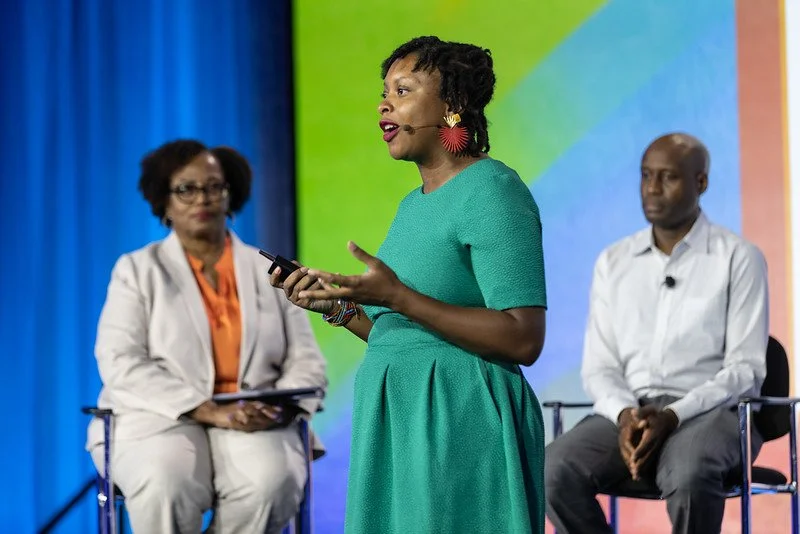
Northwest Harvest, a food bank serving communities across Washington State, partnered with Connecting the Cause to do something most organizations only talk about: put community members, volunteers, and staff in the same room and actually listen.
What working together looks likeThere is a place for you
in this work.
Whether you are just beginning to ask hard questions or you are ready to redesign your entire volunteer infrastructure, there is an entry point for where you are right now.
01
The Co-Dreaming Course
An 8-week cohort-based or self-led professional development experience for volunteer managers, community engagers and nonprofit practitioners. You will move through the framework, build implementation tools, and leave with a clear plan for your organization. Join the waitlist to be notified when the next cohort opens.
02
Consulting & Implementation
For organizations ready to embed Co-Dreaming directly into their volunteer program. We begin with a discovery call to understand where you are, where harm exists, and what structural change your program needs. From there, we build together — community councils, policy redesign, staff development, and more.
03
Facilitation & Speaking
We bring Co-Dreaming into conferences, retreats, board meetings, and learning communities. Speaking and keynotes cover conversations about power-sharing, repairing harm, and about what it means to keep community central to the work.

Ready to beginLet us build the how together.
If this framework named something you have been carrying — join the Co-Dreaming Course waitlist to be first to know when the next cohort opens. If your organization is ready to start now, book a discovery call and we will figure out together what Co-Dreaming looks like in your specific context.
Both options start with a conversation. Neither one requires you to have it all figured out.
© Co-Dreaming Framework — Connecting the Cause
The Co-Dreaming Framework, including its phases, foundational values, tools, curriculum, and methodology, is the original intellectual property of Breauna Dorelus and Connecting the Cause. This page shares the philosophy and orientation of the framework for educational purposes. The implementation tools, cohort curriculum, workshop materials, and proprietary resources are available exclusively through a working engagement with Connecting the Cause. Reproduction, adaptation, or use of this framework without written permission is not authorized.